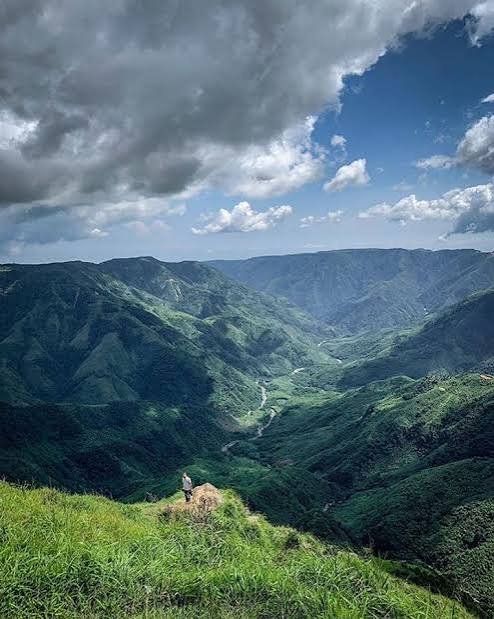
Meghalaya, which means "the abode of clouds," is a beautiful state in Northeast India, with Shillong as its capital city. It was formed on 21 January 1972 by separating the Khasi Hills, Jaintia Hills, and Garo Hills from the state of Assam. Covering an area of about 22,429 square kilometres, Meghalaya shares its borders with Assam to the north and east, and Bangladesh to the south and west. The state has a population of over 3.2 million people.
During British rule, Meghalaya was popularly known as the "Scotland of the East" because of its rolling hills, cool climate, and scenic beauty. The official languages of the state are English, Khasi, and Garo. One of Meghalaya's unique cultural features is its matrilineal society, where family lineage and property are passed down through the women. Traditionally, the youngest daughter inherits the family property and is responsible for caring for her parents.
Meghalaya is famous for its heavy rainfall and is considered the wettest state in India. Some places in the southern Khasi Hills receive an average of 12,000 millimetres of rain each year, making them among the wettest places on Earth. Around 70% of the state is covered by forests, which support a rich variety of wildlife, birds, and plant species, making Meghalaya an important biodiversity hotspot.
Agriculture is the backbone of Meghalaya's economy. Major crops grown in the state include rice, potatoes, maize, pineapples, bananas, papayas, and various spices. Forestry and the service sector also contribute to the economy, while the state is rich in minerals such as coal, limestone, and uranium, although industrial development remains limited. Meghalaya also plays an important role in trade with Bangladesh due to its strategic location and road connectivity.
Meghalaya also holds global geological significance. In 2018, the International Commission on Stratigraphy named the most recent stage of the Holocene Epoch the Meghalayan Age. The name comes from evidence found in Mawmluh Cave, where a rock formation recorded a major global climate event that occurred around 2250 BCE, making Meghalaya an important site for studying Earth's climate history.
Comments (0)