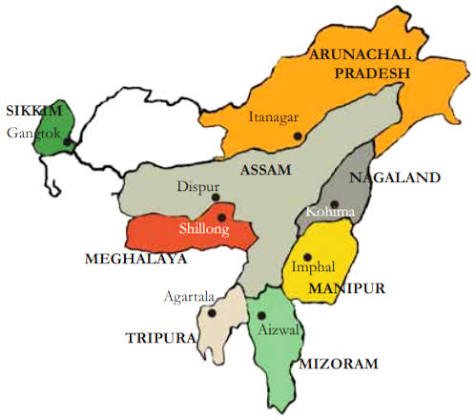
Northeast India, officially known as the North Eastern Region (NER), is the easternmost part of India. It consists of eight states: Arunachal Pradesh, Assam, Manipur, Meghalaya, Mizoram, Nagaland, Sikkim, and Tripura. The first seven states are often called the "Seven Sisters," while Sikkim later became part of the region. Northeast India is also one of the most linguistically diverse regions in the world, with hundreds of languages and dialects spoken by different communities.
The region shares a 5,182-kilometre international border with five countries: China to the north, Myanmar to the east, Bangladesh to the southwest, Nepal to the west, and Bhutan to the northwest. Covering an area of about 262,184 square kilometres, it makes up nearly 8% of India's total land area and is home to around 46 million people, which is about 4% of India's population. Northeast India is connected to the rest of the country through the narrow Siliguri Corridor, often called the "Chicken's Neck."
Northeast India is rich in natural resources, especially minerals and petroleum. The country's first oil well was drilled in Digboi, Assam, in 1865, marking the beginning of India's oil industry. The region also contains one of the world's important ophiolite formations, which are valuable for geological research.
Because of its location, Northeast India has great strategic importance. During the Second World War, it was the site of the famous Battle of Imphal and Kohima (1944), where Japanese and Allied forces fought one of the war's most intense battles. The conflict resulted in heavy casualties on both sides and played a significant role in the Allied victory in the region.
Comments (0)